What is The National Writing Board?
By
Kate Schrage
May 15, 2026
•
3
min read
Share this Article
Simply highlight text to share on social or email
What Is The National Writing Board?
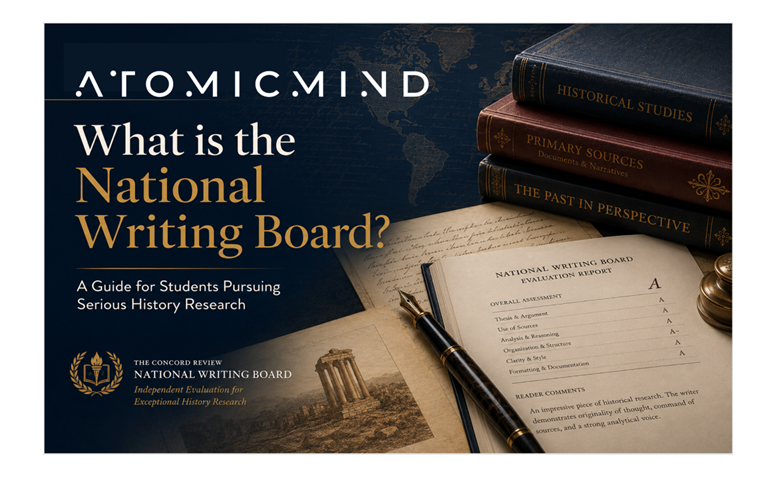
The National Writing Board (NWB) is an independent assessment service for high school history research papers, affiliated with The Concord Review — one of the most prestigious academic journals available to high school students. Unlike The Concord Review itself, the NWB doesn't publish student work. Instead, it evaluates papers through detailed score reports that students can forward directly to college admissions offices.
The process is straightforward: a student submits a completed history research paper, two experienced history scholars evaluate it, and the student receives a three-to-four-page analytical report. That report can then become part of a college application file. Think of the NWB less as a competition and more as an external academic audit — a rare form of third-party validation in high school academics that measures writing strengths against rigorous, universal standards.
Why Does the NWB Matter?
To understand the NWB's strategic value, it helps to consider the broader ecosystem. The Concord Review itself accepts roughly 5% of submissions, giving it an exceptionally strong reputation among admissions officers. The NWB extends that ecosystem by addressing a problem colleges face constantly: the lack of reliable, standardized signals for advanced humanities writing. Grades are frequently inflated. School rigor varies enormously. Teacher recommendations are inherently subjective.
The NWB functions as a standardized, external assessment that evaluates core academic competencies — research, argumentation, and writing — in a formal, digestible format that admissions officers can trust. As of publishing, NWB reports have been sent to more than 100 admissions offices across the U.S., and the program has been endorsed by dozens of selective institutions.
How Are Papers Evaluated?
Rather than assigning a single grade, the NWB scores papers across five dimensions: Reading (use of sources), Thinking (depth of understanding), Elaboration (evidence and analysis), Writing (clarity and style), and an Overall assessment. Each category is scored on a 1–6 scale, producing something resembling an academic transcript for the paper itself. The NWB doesn't simply pass or fail work — it maps exactly where a student succeeded and where they didn't.
Earning an overall score of 5 or above is generally considered a strong signal to Ivy League and Ivy Plus institutions that a student has genuine intellectual passion for the humanities and is capable of sustained, sophisticated historical research.
Sample score reports can be viewed here and here.
How Selective Is It?
Every student who submits a paper following NWB guidelines will receive a report. But scoring well is a different matter. Between 2020 and 2025, only 1.8% of submissions earned a 6 (Superior) and 13.4% earned a 5 (Very Good). Scores of 4, 3, and 2 accounted for the remaining 85%, meaning only the top 15.2% of entrants reach the threshold considered competitive for elite college consideration.
Choosing the Right Topic
For most students, the biggest obstacle to a strong NWB submission isn't writing ability — it's topic selection. The strongest papers tend to sit at the intersection of three qualities: specificity, argument potential, and source accessibility.
Specificity matters more than most students expect. Broad topics almost always underperform. "The Causes of World War I" invites a survey; "Railway Mobilization Timetables and Escalation Decisions in July 1914" invites an argument. A tightly scoped topic signals intellectual maturity and gives the paper a manageable research focus that admissions readers and NWB evaluators both find more compelling.
Argument potential is equally important. A common mistake is choosing a topic that invites summary rather than analysis. Strong topics make a debatable claim. "The Role of Women in the American Revolution" describes a subject; "How Economic Agency, Not Ideology, Shaped Women's Participation in the American Revolution" makes an argument a reasonable historian could push back on. If no one could disagree with your thesis, the topic likely needs refinement.
Source accessibility, finally, determines whether even a great idea can be executed. Before committing to a topic, confirm that sufficient scholarly secondary sources exist alongside primary materials — letters, speeches, archival documents — that can sustain a paper of 6,000 to 10,000 words or more. A sophisticated argument requires evidence density, not just intellectual creativity.
In practice, the best topics tend to emerge from a classroom moment that felt unresolved, a single compelling text that raised unanswered questions, a primary source that begged interpretation, or a longstanding personal interest explored in a new historical context.
Writing at the Level the NWB Rewards
The NWB is assessing academic writing quality, not creativity in isolation. On a granular level, that means clear and assertive topic sentences, consistent linking of evidence to argument, proper citations, and a consistent prioritization of analysis over narrative. The most common pitfalls — choosing a topic that's too broad, delaying thesis development, leaning on summarization, using weak sources, or beginning to write before fully structuring the argument — are precisely what NWB evaluators are trained to identify.
Who Should Consider Submitting?
The NWB is most effective for students who have already completed a serious research paper of 4,000 words or more, have a genuine interest in the humanities or social sciences, and are targeting highly selective colleges. It carries particular weight for students without easy access to formal research programs, for international applicants who need standardized signals to supplement their applications, and for anyone working to build a compelling, coherent spike around writing or history.
When and How to Submit
Timing matters. Ideally, students should complete an NWB submission by spring — or at the latest, early summer before senior year — so the analytical report arrives before fall application deadlines. That timeline gives students the chance to include the report as a supplemental document, integrate it into their broader academic narrative, and potentially reference it in supplemental essays.
Submission costs approximately $350, takes roughly 12 weeks for evaluation, and requires mailed physical copies in anonymized formatting. Despite the fee, the review process remains objective and rigorous. Students may also submit the same paper to both the NWB and The Concord Review simultaneously, though these are entirely separate processes.
Final Takeaway
Used thoughtfully, the NWB is a credible third-party evaluation — not a competition — that can move a humanities-focused, high-achieving student from strong to genuinely distinctive. In elite admissions, that difference often matters.
How AtomicMind Can Help
At AtomicMind, we guide students to position the NWB as validation of an already strong academic profile, as a differentiation tool among applicants with similar grades and coursework, and as an anchor for a broader academic narrative built around real intellectual passion. We work closely with students to identify high-potential research topics, build a structured research plan, develop a clear and defensible thesis, provide detailed feedback across multiple drafts, and refine writing for clarity, rigor, and originality. If you're serious about pursuing the NWB — or simply want to produce work at that level — contact us today to work with a writing specialist who can guide you through the process.

About the Author: A Cornell and Columbia graduate, Kate has been working with students since 2018, guiding them to admissions at every Ivy League school and dozens of other top universities. Her background spanning literature,education, and college advising gives her a distinctive lens for helping students identify and articulate their strengths.

Share this Article