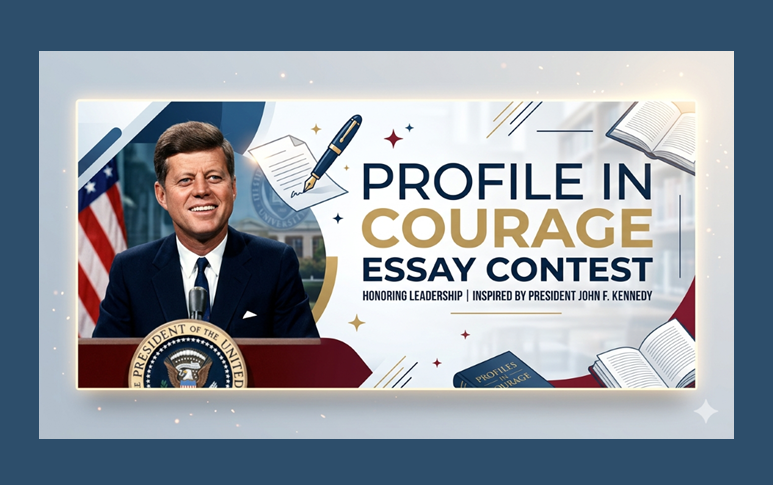
Your Complete Guide to the JFK Profile in Courage Essay Contest
By
AtomicMind Staff
March 30, 2026
•
3
min read
Share this Article
Simply highlight text to share on social or email
The Profile in Courage Essay Contest is one of the most respected civic writing competitions for U.S. high school students. Sponsored by the John F. Kennedy Library Foundation, it challenges you to dig into history, think critically about leadership, and make a real argument — not just summarize events.
If you're wondering whether it's worth your time: yes. The prizes are significant, the recognition is meaningful on college applications, and the skills you'll build along the way are genuinely useful. Here's everything you need to know.
What Is the Profile in Courage Essay Contest?
The contest asks you to analyze an act of political courage by a U.S. elected official who served during or after 1917. It's inspired by President Kennedy's Pulitzer Prize-winning book Profiles in Courage, which celebrated leaders who risked their careers to do what they believed was right — even when it was unpopular.
This isn't a typical school essay. Judges are looking for real historical research, original analysis, and a persuasive argument about what courage in politics actually looks like.
Why It Matters
- Meaningful scholarship prizes (up to $10,000)
- Strong recognition on college applications
- Builds real research and analytical writing skills
- Encourages civic engagement with history and politics
Who Can Enter?
You're eligible if you are:
- A student in grades 9–12 in the United States
- Enrolled in a public, private, parochial, or homeschool program
- A U.S. citizen attending school abroad
- Under age 20 in a high school correspondence or GED program
Essay Requirements
Before you start writing, make sure you know the rules cold. Disqualifications happen more often than you'd think.
Length & Format
- 700–1,000 words (strictly enforced)
- Citations and bibliography do NOT count toward the word limit
- At least five sources required
- Parenthetical citations required (no footnotes)
- Bibliography must be included
- Your essay must be anonymous — no identifying information anywhere
Topic Requirements
Your essay must:
- Describe and analyze a specific act of political courage
- Focus on a U.S. elected official
- Choose someone who served during or after 1917
- Explain the risks, obstacles, and consequences they faced
The issue can be local, state, national, or international — what matters is the depth of your analysis.
Originality Rules (Read This Carefully)
🚫 AI assistance is strictly prohibited. Essays may be screened for AI use.
🚫 Plagiarism results in immediate disqualification.
✅ Every word must be your own original work.
This is one of the few major competitions that explicitly checks for AI-generated content.
Required: Nominating Teacher
Every submission needs a nominating teacher — usually an English or history instructor — who reviews your essay, provides feedback, and confirms the work meets contest requirements. Loop them in early so they have enough time to help.
Choosing a Strong Topic
This is the most important strategic decision you'll make. The right subject can make your essay stand out; the wrong one can sink it no matter how well you write.
What Makes a Good Subject?
Look for elected officials who:
- Took a clear, identifiable political risk
- Faced opposition from their own party or base
- Experienced real consequences for their actions
- Are not overused contest subjects
- Have strong primary sources available (speeches, voting records, letters, news coverage)
The contest encourages students to consider local or lesser-known figures. A well-researched essay about a state legislator can outperform a generic essay about a famous senator.
What Makes a Winning Essay?
Based on past winners and the judging rubric, top submissions consistently do five things:
- Define political courage clearly. Don't assume the reader knows what courage means in a political context. Show what was actually at stake for this official.
- Prove the risk was real. Career risk, public backlash, political isolation — make the stakes concrete and specific.
- Use strong primary sources. Speeches, letters, voting records, and contemporaneous news articles carry more weight than secondary summaries.
Build a clear argument. This isn't just storytelling. Make a claim about courage and support it with evidence. - Connect past to present. Explain why this act of courage still matters today.
How Your Essay Is Judged
Understanding the rubric is essential. Judges evaluate three main areas:
Research Quality
- Five or more reliable, well-chosen sources
- Use of primary sources (not just Wikipedia or textbooks)
- Thoughtful, intentional source selection
Writing Quality
- Clear, engaging style
- Logical organization with a strong intro and conclusion
- Correct grammar and mechanics
Historical & Analytical Depth
- Strong political context that shows you understand the era
- Honest evaluation of the real risks the official faced
- Assessment of short- and long-term consequences
- Independent thinking — your analysis, not someone else’s
Disqualification Pitfalls to Avoid
❌ Essay under 700 or over 1,000 words
❌ Fewer than five sources
❌ Late submission
❌ Subject served before 1917
❌ Subject is not an elected official
❌ Identifying information included in the essay
❌ Evidence of AI assistance
❌ Plagiarism of any kind
Why Colleges Pay Attention to This Contest
The Profile in Courage Essay Contest signals something specific to admissions officers: you can do college-level research, construct a sustained argument, and engage seriously with history and civic life.
Even an honorable mention can be meaningful on selective college applications. First-place and finalist recognition at a nationally recognized competition is genuinely impressive.
Final Tips for Success
- Start early — the research takes longer than you expect
- Choose an uncommon but well-documented figure
- Emphasize risk, not just moral goodness
- Use primary sources strategically and cite them carefully
- Follow all formatting rules exactly — no exceptions
- Avoid AI use entirely
Students who treat this like a mini historical research paper — rather than a typical school essay — consistently produce the strongest work. Good luck!
At AtomicMind, our expert counselors help students choose compelling topics, develop original arguments, and craft essays that stand out to judges. Whether you're just getting started or need a second set of eyes on your draft, we're here to help you put your best work forward.

Share this Article