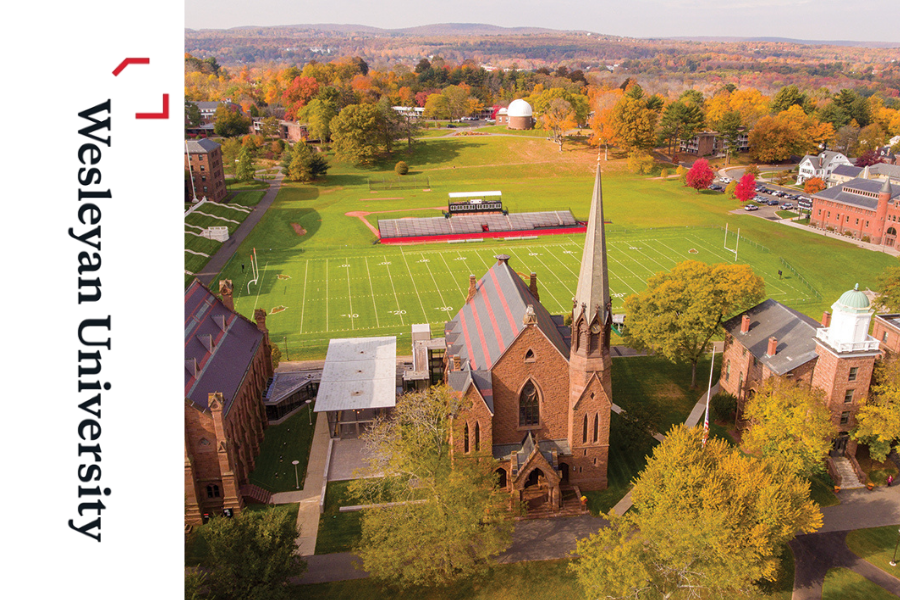
Why Apply to Wesleyan University?
By
AtomicMind Staff
August 26, 2026
•
3
min read
Share this Article
Simply highlight text to share on social or email
Some universities produce excellent students. Wesleyan seems to produce creators.
Not necessarily the students with the highest test scores or the most conventional résumés, but the people who go on to write Broadway musicals, create television shows, direct Oscar-winning films, found companies, publish bestselling novels, and redefine entire artistic fields.
It's difficult to explain exactly why.
Part of it is Wesleyan's remarkable commitment to the liberal arts. Part of it is its culture of experimentation. But perhaps most importantly, Wesleyan attracts students who are just as excited about making something as they are about studying it.
If you've ever looked at your list of interests and worried they don't fit together (physics and theatre, politics and filmmaking, computer science and music composition) Wesleyan might feel like home.
What Is Wesleyan Known For?
Founded in 1831, Wesleyan enrolls approximately 3,000 undergraduate students in Middletown, Connecticut. As one of the country's premier liberal arts colleges, Wesleyan is known for outstanding teaching across the humanities, social sciences, natural sciences, and the arts.
But it has developed an especially remarkable reputation for producing leaders in:
- film and television
- theatre
- music
- writing
- public service
- entrepreneurship
Its alumni include composer Lin-Manuel Miranda, whose early version of In the Heights began as a Wesleyan student production; television creators Craig Thomas and Carter Bays (How I Met Your Mother); actor Bradley Whitford; filmmaker Michael Bay; author Joss Whedon; documentary filmmaker Sebastian Junger; and journalist John Yang, among many others.
The breadth of these careers is telling. Wesleyan doesn't simply train artists. It cultivates people who create culture.
What Makes Wesleyan Academically Different?
Creativity Is the Curriculum
Many universities encourage creativity. Wesleyan expects it.
Students are encouraged to combine disciplines in unexpected ways and pursue independent projects early in their undergraduate careers. Rather than seeing the arts and sciences as separate worlds, Wesleyan treats them as complementary ways of understanding the world.
It's entirely normal for a neuroscience major to direct a student play, or for a music student to take advanced political philosophy seminars.
This isn't extracurricular enrichment. It's the educational philosophy.
A Liberal Arts College That Feels Like a Creative Studio
Wesleyan's classes are small, discussion-based, and intellectually demanding.
But unlike some liberal arts colleges that can feel intensely academic in a traditional sense, Wesleyan places unusual emphasis on making as well as thinking. Students write screenplays, compose operas, produce podcasts, launch magazines, stage original theater, create documentaries, build games, and more.
Faculty generally encourage experimentation rather than perfection, creating an atmosphere where ambitious ideas are welcomed, even when they don't quite work.
Collaboration Over Competition
One reason Wesleyan alumni remain so influential is that many begin collaborating while they are still students. Lin-Manuel Miranda didn't simply study theatre at Wesleyan; he met future collaborators there.
The same is true across film, television, journalism, politics, and entrepreneurship.
Wesleyan's relatively small size means students constantly encounter people with different talents. A playwright quickly finds actors. A filmmaker meets composers. A political science major finds graphic designers. The result is a campus where ideas rarely stay confined to one department.
What Is Student Life Like?
If Wesleyan has a defining characteristic outside the classroom, it's probably creative energy.
Walk across campus and you'll encounter rehearsals, art exhibitions, student publications, concerts, comedy shows, activist meetings, dance performances, hackathons, and philosophical debates, sometimes all in the same evening.
The arts aren't siloed in one building or reserved for majors. They're woven into campus life.
That doesn't mean everyone is an artist; it means almost everyone is creating something.
Students are also deeply engaged in public service, social justice, entrepreneurship, and civic engagement. Wesleyan has long been known as one of the more politically active liberal arts colleges, where intellectual discussion often extends naturally into community action.
Who Thrives at Wesleyan?
Wesleyan is an excellent fit for students who:
- have multiple intellectual and creative interests;
- enjoy discussion more than lectures;
- want professors who know them personally;
- are excited by collaboration;
- value originality over convention.
This is not the best place for students looking for a highly pre-professional, structured experience. It's a place for people who ask unusual questions, pursue unconventional combinations of interests, and genuinely enjoy making things with other people.
Applying to Wesleyan: Let Your Work Speak for Itself
Unlike many highly selective colleges, Wesleyan does not currently require a supplemental essay. Applicants apply through the Common Application and submit the standard personal statement.
This means your Common App essay becomes especially important. Without additional written prompts, admissions officers rely more heavily on your personal statement, activities list, recommendations, and academic record to understand who you are and what you would contribute to campus.
Optional Artistic Supplements
Students with significant experience in the arts may also submit optional portfolios through SlideRoom in areas such as:
- Music
- Theatre
- Dance
- Film
- Visual Arts
These supplements are not required, but they can provide valuable additional context for students whose creative work is an important part of their identity or intended college experience.
Even if you don't plan to major in the arts, submitting a strong portfolio can help demonstrate the seriousness of your creative practice.
A Final Piece of Advice
Because Wesleyan doesn't ask a separate "Why Us?" essay, it's worth making sure your application still conveys why the university is a natural fit. Your Common App essay, activities list, and any optional portfolio should work together to tell a coherent story about your intellectual curiosity, creativity, and collaborative spirit…the qualities that have long defined the Wesleyan community.
Final Thoughts
Wesleyan isn't trying to produce one type of graduate.
It's trying to produce people who will create something new.
That might be a Broadway musical.
A television series.
A groundbreaking scientific discovery.
A startup.
A novel.
Or an entirely new career that doesn't exist yet.
If you're looking for a college where creativity isn't confined to the arts and where your classmates are just as likely to become collaborators as competitors, Wesleyan is one of the most distinctive liberal arts colleges in the world.
Need Help With Your Wesleyan Application?
At AtomicMind, we help students identify the colleges that truly match how they learn, think, and create. If Wesleyan's interdisciplinary, collaborative culture speaks to you, we'll help you craft an application that reflects your authentic voice, intellectual curiosity, and creative ambitions.

Share this Article