Why Apply to the University of Rochester?
By
AtomicMind Staff
August 10, 2026
•
3
min read
Share this Article
Simply highlight text to share on social or email
The University of Rochester isn't usually the first university students mention when they talk about elite colleges. And that's precisely why it deserves much more attention.
For decades, Rochester has quietly built an exceptional academic reputation. In recent years, however, the rest of the world has started to notice. Applications have increased dramatically, admission has become substantially more selective, and Rochester has established itself as one of the country's premier research universities.
Yet unlike many institutions that have risen rapidly in the rankings, Rochester hasn't fundamentally changed who it is. It has always been a place that values intellectual curiosity, interdisciplinary thinking, and academic independence. Students are simply discovering what faculty, graduate schools, and employers have known for years.
If you're looking for a university that combines world-class academics with remarkable flexibility and offers opportunities that rival schools with far greater name recognition, Rochester deserves a place on your college list.
What Is the University of Rochester Known For?
Founded in 1850, the University of Rochester enrolls roughly 6,800 undergraduate students, making it one of the smaller research universities among its peers. The university is particularly renowned for:
- the Eastman School of Music, consistently regarded as one of the world's leading music conservatories;
- the Simon Business School, especially in economics, finance, and quantitative business;
- exceptional programs in optics, engineering, neuroscience, political science, and more;
- a longstanding culture of undergraduate research.
Although Eastman and Simon also serve graduate students, they contribute enormously to Rochester's intellectual environment, creating opportunities for collaboration across disciplines that are unusual at the undergraduate level.
What Makes Rochester Academically Different?
The Open Curriculum
If Brown is famous for its Open Curriculum, Rochester quietly pioneered a remarkably similar philosophy decades ago. Rather than requiring students to complete a long list of general education courses, Rochester asks them to achieve both breadth and depth through its unique cluster system.
Students complete a major and a single required academic writing course while concurrently pursuing coursework in two additional academic divisions outside that major. An engineering student might cluster in music and philosophy. A biology major might study economics and creative writing.
The result is flexibility without chaos. Students are encouraged to explore broadly while still developing genuine expertise.
Research Isn't Reserved for Graduate Students
As a member of the Association of American Universities (AAU), Rochester produces cutting-edge research across disciplines. What's remarkable is how accessible that research is to undergraduates.
With the support of the Office of Undergraduate Research, students frequently join research labs during their first or second year, working alongside faculty in fields ranging from neuroscience and economics to political science and engineering. Independent research, funded summer projects, and close faculty mentorship are common rather than exceptional.
Because Rochester is smaller than many peer institutions, undergraduates often enjoy levels of faculty access that would be difficult to find elsewhere.
Eastman Raises the Bar for Everyone
Even students who never set foot in the Eastman School of Music benefit from its presence. Located just a few minutes from the main River Campus, Eastman consistently ranks among the finest music conservatories in the world. Students across the university can attend performances by internationally renowned musicians, collaborate with talented performers, and participate in an unusually rich artistic community. For students pursuing music seriously, but not necessarily as a conservatory major, this creates extraordinary opportunities.
More broadly, Eastman reinforces Rochester's philosophy that excellence in the arts belongs alongside excellence in science, engineering, medicine, and business.
An Unexpectedly Beautiful Campus
Rochester's campus often surprises visitors. The River Campus sits along the Genesee River and combines traditional collegiate Gothic architecture with striking examples of modern design.
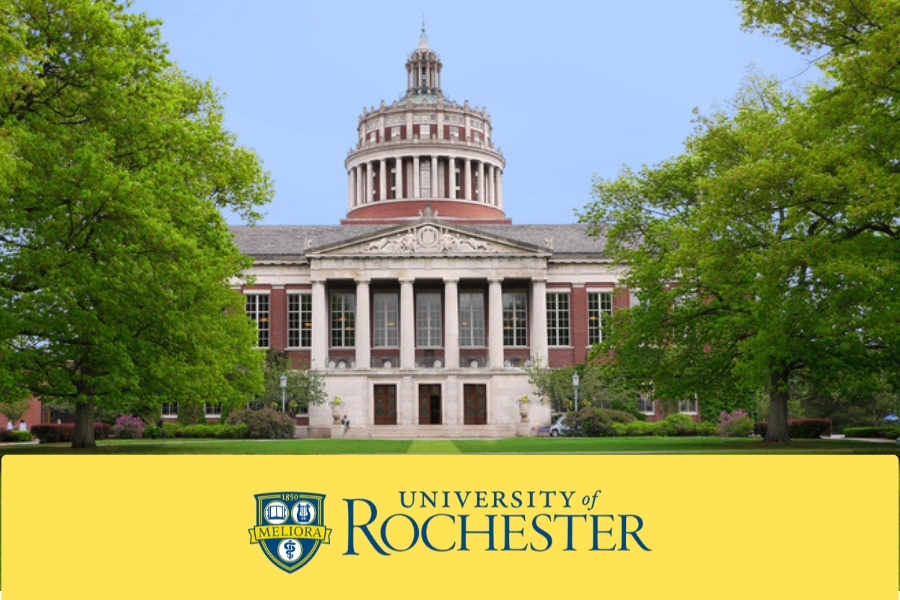
Perhaps the most famous is Wilson Commons, designed by I. M. Pei, a stunning example of modern architecture. Older buildings give the campus an Ivy League feel, for instance the Rush Rhees Library and its distinctive circular skylight affectionately known as "the Nipple of Knowledge." It is one of those wonderfully quirky campus traditions that students immediately understand and visitors never forget.
Elsewhere, students move between historic stone buildings, expansive green spaces, and the nearby Genesee River, creating a campus that feels both peaceful and intellectually vibrant.
Architecture may not determine where you spend four years, but the places where you learn inevitably shape how you experience college.
What Is Student Life Like?
Despite its rigorous academics, Rochester has a remarkably collaborative atmosphere.
Students tend to be curious rather than competitive. Conversations move easily from quantum physics to jazz improvisation, from political philosophy to entrepreneurship.
This interdisciplinary culture extends outside the classroom through more than 250 student organizations, undergraduate research groups, performing ensembles, entrepreneurship competitions, and community engagement initiatives.
Music is particularly woven into campus life. You don't have to be an Eastman student to join orchestras, chamber groups, jazz ensembles, or a cappella groups, and performances are a regular part of life on campus.
Meanwhile, Rochester's location offers internships in healthcare, optics, engineering, business, education, and public policy, particularly through the university's close relationship with the University of Rochester Medical Center, one of the nation's leading academic medical centers.
Who Thrives at Rochester?
Rochester is an ideal fit for students who:
- genuinely enjoy learning across disciplines;
- want flexibility without sacrificing academic rigor;
- seek close relationships with faculty;
- are excited by undergraduate research;
- appreciate a collaborative rather than competitive culture.
Many Rochester students have multiple passions and refuse to choose between them. They might be future physicians who perform chamber music, engineers who study philosophy, economists who conduct neuroscience research, or political scientists who write novels.
At Rochester, that kind of intellectual range isn't unusual—it's encouraged.
Rochester Essays: Curiosity and Academic Fit
Rochester requires one supplemental essay: The University of Rochester is a place where curiosity and creativity meet. How will you combine our academic flexibility and co-curricular opportunities to create an experience that reflects your interests and ambitions? (250 words)
At first glance, this looks like a traditional "Why Us?" essay, but it's actually asking something more ambitious. Rochester isn't simply asking why you want to attend; it wants to know what you will build once you're there.
The strongest essays don't just list majors, clubs, and research opportunities. Instead, they paint a picture of how you'll combine Rochester's distinctive features (its cluster curriculum, undergraduate research opportunities, student organizations, artistic resources, and collaborative culture) to create an undergraduate experience that couldn't exist anywhere else.
This is also a good opportunity to demonstrate intellectual range. Rochester values students who refuse to stay in a single lane, so don't be afraid to show how seemingly unrelated interests connect. Perhaps you'll combine neuroscience with music, computer science with linguistics, or economics with public health. The admissions committee wants to see not just what you're interested in today, but how Rochester's flexibility will help those interests evolve.
Above all, be specific. Generic praise about Rochester's rankings or beautiful campus won't distinguish your application. Show that you understand what makes Rochester unique and how you plan to take full advantage of it.
Final Thoughts
The University of Rochester has spent decades quietly building one of the strongest undergraduate experiences in the country. Its flexible curriculum, outstanding faculty, exceptional research opportunities, remarkable music culture, and collaborative community have long made it a favorite among those who know higher education well. Now, as admissions become increasingly competitive, more students are beginning to discover what has always been true:
Rochester isn't an "up-and-coming" university because it suddenly became excellent; it's up-and-coming because the rest of the world is finally catching up.
Need Help With Your Rochester Application?
At AtomicMind, we help students look beyond rankings to identify universities where they'll truly thrive. Whether you're drawn to Rochester's open curriculum, interdisciplinary culture, or exceptional research opportunities, we'll help you craft an application that demonstrates genuine fit and shows why you're ready to take advantage of everything Rochester has to offer.

Share this Article