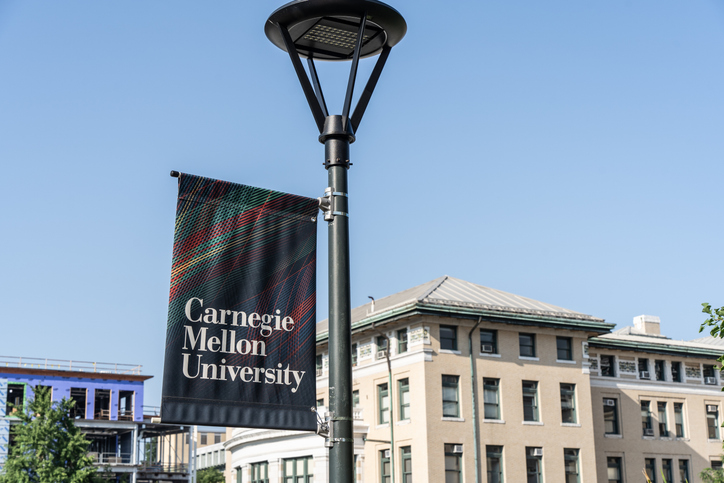
Why Apply to Carnegie Mellon University?
By
AtomicMind Staff
September 2, 2026
•
3
min read
Share this Article
Simply highlight text to share on social or email
Mention Carnegie Mellon, and most people immediately think of computer science. They're not wrong.
Carnegie Mellon consistently ranks among the very best universities in the world for computer science, artificial intelligence, robotics, cybersecurity, and engineering. Its graduates have helped build companies like Google, Nvidia, Duolingo, and countless startups, while its researchers continue to shape the future of AI and robotics.
But that's only half the story.
Carnegie Mellon is also home to one of the world's finest drama schools, an internationally respected school of design, outstanding architecture and music programs, and one of the most collaborative interdisciplinary cultures in higher education.
It's one of the rare places where a robotics engineer might work alongside a theatre student, where designers collaborate with programmers, and where artists learn to code while computer scientists study human behavior.
If you're someone who loves creating (whether that's software, films, robots, performances, products, or businesses), Carnegie Mellon offers an educational environment unlike almost any other.
What Is Carnegie Mellon Known For?
Founded in 1900 by industrialist Andrew Carnegie, Carnegie Mellon enrolls roughly 7,300 undergraduate students across seven colleges. Among its most renowned schools are:
- School of Computer Science
- College of Engineering
- Tepper School of Business
- School of Drama
- School of Design
- School of Music
- Dietrich College of Humanities and Social Sciences
Unlike many universities where the arts and sciences operate independently, Carnegie Mellon actively encourages collaboration across disciplines.
That philosophy has helped make it a global leader not only in technology, but also in design, entertainment, entrepreneurship, and human-centered innovation.
What Makes Carnegie Mellon Academically Different?
Building Things Is the Curriculum
Many universities teach students to analyze problems; Carnegie Mellon teaches students to build solutions.
Whether you're writing software, designing costumes, composing music, creating interactive experiences, developing robots, or launching a startup, project-based learning is woven throughout the curriculum.
Students rarely leave class with only theoretical knowledge. They leave having designed, tested, prototyped, performed, or built something tangible.
Where Technology Meets Creativity
Perhaps no university embodies STEAM education better than Carnegie Mellon.
Long before "interdisciplinary" became a buzzword, CMU students were combining computer science with art, engineering with design, psychology with artificial intelligence, and music with robotics.
The university is widely recognized as the birthplace of Human-Computer Interaction (HCI) as an academic discipline, reflecting its belief that technology should be designed around people rather than the other way around.
That mindset permeates the campus.
Even students who never formally study HCI often collaborate across disciplines to solve real-world problems.
Undergraduate Research and Innovation
As one of the world's leading research universities, Carnegie Mellon offers extensive opportunities for undergraduate research.
Students work with faculty on projects involving machine learning, cybersecurity, neuroscience, public policy, behavioral economics, robotics, sustainability, and countless other fields.
Many also participate in entrepreneurial initiatives through the Swartz Center for Entrepreneurship, where ideas developed in undergraduate classrooms sometimes become real companies.
The School of Drama: A Hidden Superstar
While Carnegie Mellon is synonymous with technology, its School of Drama is equally legendary.
As the oldest degree-granting drama program in the United States, it has produced an astonishing number of actors, directors, playwrights, and performers.
Its alumni include Holly Hunter, Ted Danson, Billy Porter, Leslie Odom Jr., Judith Light, Renée Elise Goldsberry, Ming-Na Wen, Joe Manganiello, and many others.
Like the engineering programs, Drama emphasizes intensive professional training, collaboration, and constant practice. The result is an artistic culture that is just as rigorous as Carnegie Mellon's technical programs.
What Is Student Life Like?
Carnegie Mellon students have a reputation for being wonderfully and unapologetically nerdy.
They're curious. Creative. Driven. And often deeply passionate about very specific interests.
It's the sort of campus where you'll find robotics competitions happening next to improv rehearsals, game designers collaborating with composers, and engineers attending student theatre productions.
Despite the demanding academics, students consistently describe the campus as collaborative rather than cutthroat. Many projects require teamwork across disciplines, and students quickly learn that the best ideas often emerge when different perspectives come together.
Pittsburgh itself has also become one of CMU's greatest assets. Once known primarily as a steel city, it has reinvented itself as a center for healthcare, robotics, artificial intelligence, finance, and technology. Companies such as Google, Apple, Nvidia, Duolingo, Aurora, and many others have major operations in the region, creating abundant internship and employment opportunities.
Who Thrives at Carnegie Mellon?
Carnegie Mellon is an excellent fit for students who:
- love solving difficult problems;
- enjoy making things rather than simply studying them;
- are comfortable with challenging coursework;
- thrive in collaborative, project-based environments;
- have deep passions, whether technical, artistic, or both.
CMU students often describe themselves as people who become completely absorbed in a project simply because they find it fascinating.
If that sounds like you, you'll probably fit right in.
Carnegie Mellon Essays: Passion, Purpose, and Self-Reflection
Carnegie Mellon's supplemental essays are refreshingly introspective. Rather than asking you to simply explain why you want to attend CMU, the admissions committee wants to understand what drives you, how you think about learning, and what you want them to know that isn't already evident elsewhere in your application.
For the 2026–2027 application cycle, applicants respond to three short-answer questions, each with a 300-word limit.
Essay 1: What Inspired Your Academic Interests?
Most students choose their intended major or area of study based on a passion or inspiration that's developed over time — what passion or inspiration led you to choose this area of study?
Strategy:
This isn't asking for your résumé. Carnegie Mellon wants to understand where your intellectual curiosity comes from.
The strongest responses trace the evolution of an interest rather than simply stating that you've always loved computer science, theatre, engineering, or design. Perhaps one project sparked a fascination that grew into independent research. Maybe an unexpected class, a personal experience, or even a failure sent you down a path you hadn't anticipated.
Remember that you are applying directly to a specific school within Carnegie Mellon, so connect your story to your intended field of study. Show admissions not only what you want to study, but why that subject continues to challenge and excite you.
Essay 2: What Does Success Look Like?
Many students pursue college for a specific degree, career opportunity or personal goal. Whichever it may be, learning will be critical to achieve your ultimate goal. As you think ahead to the process of learning during your college years, how will you define a successful college experience?
Strategy: This question is subtly different from "What are your career goals?" Instead, Carnegie Mellon is asking how you define learning itself.
Of course, it's perfectly reasonable to mention professional ambitions, but don't stop there. Think about the kind of person you hope to become over the next four years. Perhaps success means conducting meaningful research, collaborating with classmates from different disciplines, taking intellectual risks, or discovering entirely new interests outside your major.
Because Carnegie Mellon is known for its project-based, interdisciplinary culture, strong essays often move beyond outcomes ("I want to become an engineer") and instead focus on the experiences that will shape that journey.
Essay 3: What Else Should We Know?
Consider your application as a whole. What do you personally want to emphasize about your application for the admission committee's consideration? Highlight something that's important to you or something you haven't had a chance to share. Tell us, don't show us (no websites please).
Strategy: This is your opportunity to fill in the gaps. Rather than repeating information already found in your activities list or Common App essay, ask yourself: What's an important part of who I am that the admissions committee still doesn't know?
Perhaps it's an intellectual interest that doesn't fit neatly into your extracurricular activities, an unusual hobby, a personal value that shapes your decisions, or an experience that provides important context for your application.
The prompt's instruction to "tell us, don't show us" is unusual. Carnegie Mellon isn't asking for a dramatic narrative here. Instead, it's inviting thoughtful reflection and honest explanation. Sometimes a straightforward, deeply personal response can be far more memorable than an elaborate story.
Taken together, Carnegie Mellon's supplements should tell a coherent story.
- The first essay explains what inspires your academic interests.
- The second explores what you hope to gain from your education.
- The third reveals the person behind the transcript.
Throughout your responses, remember that Carnegie Mellon is looking for more than talented students. It wants intellectually curious people who are excited to immerse themselves in a demanding, collaborative environment and who have thought carefully about how they will contribute to the particular college or school to which they are applying.
Unlike many universities, CMU admits students directly into one of its undergraduate colleges, so demonstrating a clear understanding of your intended academic program and why it's the right fit for your goals can strengthen your application considerably.
Final Thoughts
Carnegie Mellon isn't simply a university for future engineers. Or future actors. Or future entrepreneurs. It's a university for people who love to create.
Its greatest strength lies not in any single department, but in the conversations that happen between them. Artists learn from engineers. Computer scientists collaborate with designers. Musicians work alongside roboticists.
In an era when innovation increasingly happens at the intersection of disciplines, Carnegie Mellon has spent decades building exactly that kind of community.
If you want an education that is rigorous, hands-on, and relentlessly creative, Carnegie Mellon may be one of the best places in the world to begin.
Need Help With Your Carnegie Mellon Application?
At AtomicMind, we help students craft applications that go beyond grades and accomplishments to reveal how they think, solve problems, and create. Whether you're applying to Computer Science, Drama, Engineering, Design, Business, or another program, we'll help you develop essays that demonstrate both your intellectual curiosity and your fit for Carnegie Mellon's uniquely interdisciplinary culture.

Share this Article