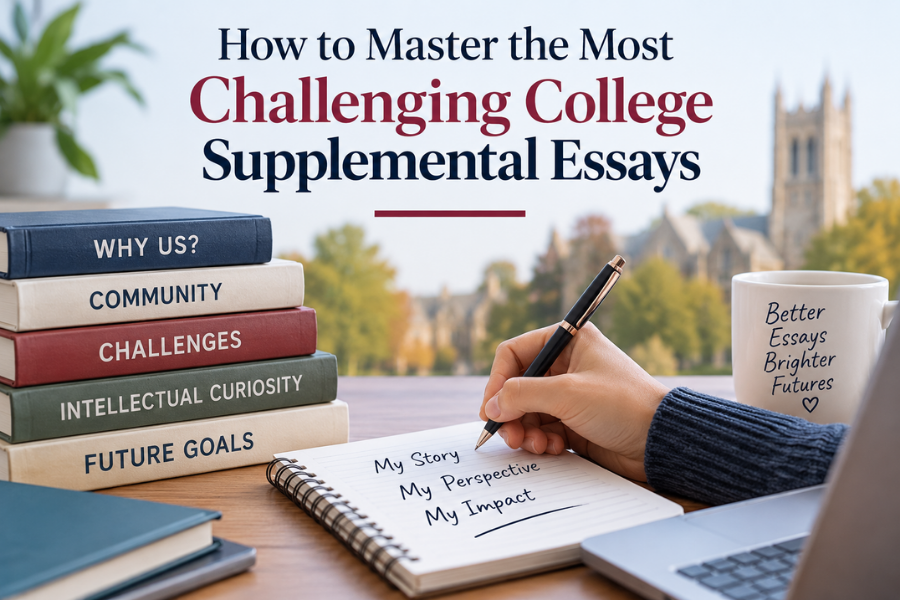
Beyond "Why Us?"
By
AtomicMind Staff
September 24, 2026
•
3
min read
Share this Article
Simply highlight text to share on social or email
By the time you've finished your Common App Personal Statement, it's tempting to think the hardest part of the application is over. Then you open a college's supplemental essays.
One school asks why you want to attend. Another wants to know how you'll contribute to its community. A third asks about an intellectual experience that changed the way you think. A fourth gives you just 50 words to answer an impossibly broad question.
Suddenly, every college seems to be asking something completely different.
Or are they?
The truth is that while supplemental essays come in countless forms, most of them are trying to answer just a handful of questions. Once you understand what admissions officers are really asking, these essays become much less intimidating.
Every Supplemental Essay Has a Purpose
Unlike the Personal Statement, which introduces you as a person, supplemental essays help colleges determine whether you're a good fit for their campus. That's why different colleges ask different questions. They're looking for different qualities based on their institutional mission, academic philosophy, and campus culture.
For example, the University of Chicago is famous for its unconventional prompts because it values creativity and intellectual playfulness. Stanford asks applicants to respond to several short questions designed to reveal personality and character, including the infamous “What is the most significant challenge that society faces today?” in just 50 words. MIT focuses on collaboration, community, and problem-solving.
The prompts may look different, but each one is designed to answer a similar question: "How will this student contribute to our community?"
The "Why Us?" Essay Isn't Really About the College
The most common supplemental essay asks some version of: "Why do you want to attend our university?"
Students often respond by describing the college:
- It has beautiful buildings.
- It offers world-class professors.
- It has an excellent engineering program.
- It ranks highly.
The problem? Every applicant can find those facts on the university's website. Admissions officers already know what's great about their institution! They're trying to understand why it's the right place for you.
A strong "Why Us?" essay builds connections between your interests and specific opportunities the college offers. Maybe a particular research lab aligns with your academic goals. Perhaps a unique interdisciplinary program fits the way you like to learn. Maybe a student organization perfectly matches an interest you've pursued throughout high school.
The key is specificity.
The more personal the connection, the more convincing your answer becomes.
Show That You've Done Your Homework
One of the easiest ways to make a supplemental essay stand out is to move beyond the admissions homepage.
Explore:
- Academic departments
- Research institutes
- Undergraduate research opportunities
- Student organizations
Special academic programs
- Campus traditions
- Study abroad opportunities
University newspapers can also provide an authentic glimpse into campus life.
For example:
Reading student publications often helps you discover opportunities and traditions that don't appear in admissions brochures.
Community Essays Ask a Different Question
Many colleges now ask students how they'll contribute to campus. These prompts may mention community directly, or they may ask about belonging, collaboration, leadership, or making an impact.
The mistake many applicants make is focusing entirely on what they hope to gain from college.
Instead, admissions officers are also wondering:
- What will everyone else gain from having you here?
- Think about the communities you've already been part of.
- How do you naturally contribute?
- Do you organize people?
- Solve problems?
- Build connections?
- Ask thoughtful questions?
- Bring humor to stressful situations?
Often, your contributions are more visible in your everyday interactions than in your biggest accomplishments.
Intellectual Curiosity Is More Than Loving School
Some colleges ask applicants to discuss an idea, question, or subject that fascinates them. Students often mistake these prompts for opportunities to list academic achievements.
They're not.
Admissions officers aren't asking whether you earned an A in chemistry (they can see that on your transcript). They're asking whether you enjoy learning for its own sake.
Maybe you became fascinated by medieval architecture after visiting Italy. Maybe one economics podcast changed how you think about public policy. Maybe you spent an entire weekend teaching yourself astrophotography simply because you were curious.
Those moments reveal something much more valuable than another accomplishment: genuine intellectual engagement.
The Shortest Essays Can Be the Hardest
Many colleges include responses of just 35, 50, or 100 words. Because they're so short, students often assume they require less effort. Usually, the opposite is true.
Writing concisely forces you to identify exactly what matters. Every sentence (and often every word) needs a purpose.
When working with very short responses, eliminate repetition, avoid lengthy introductions, and focus on one clear idea instead of trying to include everything. And the most important rule: DON’T waste your precious words repeating the question in your answer!
Don't Repeat Your Personal Statement
Another common mistake is recycling the same story across multiple essays. Admissions officers read your entire application. If your Personal Statement already discusses your robotics project, your supplemental essays should probably reveal something else about you.
Think of each essay as another window into your personality. Together, they should create a fuller picture than any single essay could accomplish alone.
Authenticity Matters More Than Guessing the "Right" Answer
Students often spend too much time trying to decode what colleges want to hear, but supplemental essays aren't personality tests with hidden correct answers.
If a college asks about your community, don't invent volunteer work because you think it sounds impressive. If it asks about intellectual curiosity, don't pretend you're fascinated by quantum mechanics if what genuinely excites you is film history or urban planning. Admissions officers can usually tell the difference between genuine enthusiasm and manufactured interest. The strongest essays sound like they could only have been written by one student.
Final Thoughts
The trickiest supplemental essays aren't testing your creativity or your ability to write under pressure; they're testing something much simpler:
- Have you taken the time to understand yourself?
- Have you taken the time to understand the college?
- And can you explain why those two stories belong together?
When you stop viewing supplemental essays as obstacles and start seeing them as opportunities to demonstrate fit, they become much easier to approach.
Need Help With Some of Your Trickier Supplementals?
At AtomicMind, we help students move beyond generic responses and craft supplemental essays that are thoughtful, specific, and authentic. From "Why Us?" essays to the most unconventional university prompts, our advisors help students understand what colleges are really asking and how to answer with confidence.

Share this Article